

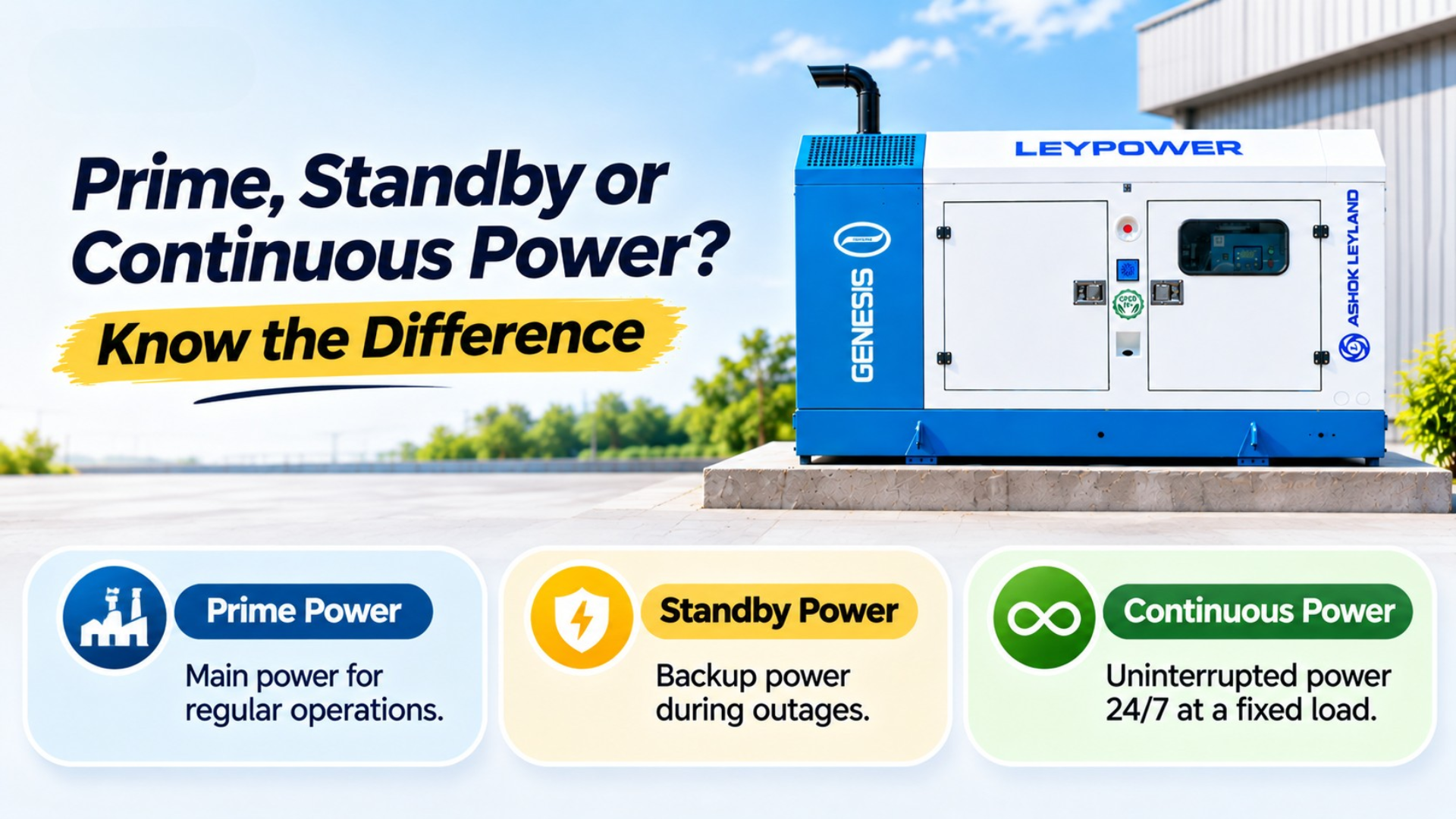
What Is the Difference Between Prime Power, Standby Power, and Continuous Power in Generators?
Choosing the right diesel generator is important for ensuring a reliable power supply for residential, commercial, and industrial applications. However, generator ratings such as Prime Power, Standby Power, and Continuous Power can often be confusing. Each rating represents a different operating condition and is designed for specific power requirements.
Understanding these differences helps businesses select the right generator, avoid overloading, and ensure reliable performance.
1. What Is Standby Power?
Standby Power is the maximum power a generator can supply during an emergency power outage when the main electricity supply is unavailable.
It is designed for occasional use and operates for a limited number of hours, depending on the manufacturer's specifications. Standby generators are commonly used in hospitals, offices, commercial buildings, and residential properties where backup power is required.
Key Features:
-
Provides backup during utility power failures.
-
Designed for emergency and occasional operation.
-
Not intended for continuous power supply.
-
Generally does not permit overload operation.
2. What Is Prime Power?
Prime Power is the power a generator can supply for an unlimited number of hours annually under variable load conditions, subject to the manufacturer's specified operating limits.
It is suitable for locations where the utility grid is unavailable or unreliable. Prime-rated generators are commonly used at construction sites, remote industrial facilities, mining operations, and temporary project locations.
Key Features:
-
Suitable for extended operating periods.
-
Supports varying electrical loads.
-
Designed for applications requiring regular power generation.
-
Allows limited overload capacity only when specified by the manufacturer and applicable rating standard.
3. What Is Continuous Power?
Continuous Power is the power a generator can supply continuously at a constant load for an unlimited number of hours annually, subject to manufacturer specifications.
It is commonly used in industrial facilities, remote locations, and operations that require a consistent electricity supply throughout the day.
Key Features:
-
Designed for continuous operation.
-
Supports a constant electrical load.
-
Suitable for applications requiring uninterrupted power generation.
-
Does not generally include an overload allowance.
4. Key Differences Between Generator Power Ratings
| Parameter | Standby Power | Prime Power | Continuous Power |
|---|---|---|---|
| Main Purpose | Emergency backup | Regular power supply | Constant power supply |
| Operating Hours | Limited | Unlimited annually | Unlimited annually |
| Load Condition | Variable | Variable | Constant |
| Overload Capacity | Not permitted | As specified | Not permitted |
| Common Applications | Offices, hospitals | Construction, mining | Industrial operations |
Actual operating limits and overload allowances depend on the applicable rating standard and generator manufacturer's specifications.
5. How to Choose the Right Generator Power Rating?
Selecting the right rating depends on your application and operating requirements.
-
Choose Standby Power if you need backup electricity during occasional power failures.
-
Choose Prime Power if your business requires regular electricity with varying loads.
-
Choose Continuous Power if your operation needs a constant power supply for extended periods.
Consider the connected load, operating hours, load variations, and future power requirements before making a decision.
Frequently Asked Questions (FAQs)
1. Can a standby generator run continuously?
Standby generators are designed for emergency operation within specified limits, not continuous use. Check the manufacturer's operating guidelines.
2. Is Prime Power higher than Standby Power?
Prime Power ratings are generally lower than Standby Power ratings for the same generator model because they are designed for different operating conditions.
3. Which generator rating is suitable for construction sites?
Prime Power is generally suitable for construction sites where generators operate for extended periods with varying electrical loads.
4. Which power rating is best for industrial applications?
Prime or Continuous Power may be suitable depending on whether the industrial facility has variable or constant electrical loads.
Standby, Prime, and Continuous Power ratings serve different generator applications. Understanding their operating conditions helps businesses choose the right generator, maintain equipment reliability, and avoid unnecessary operating costs. Always consult the manufacturer's technical specifications before selecting a generator for your power requirements.
Comments (0)