

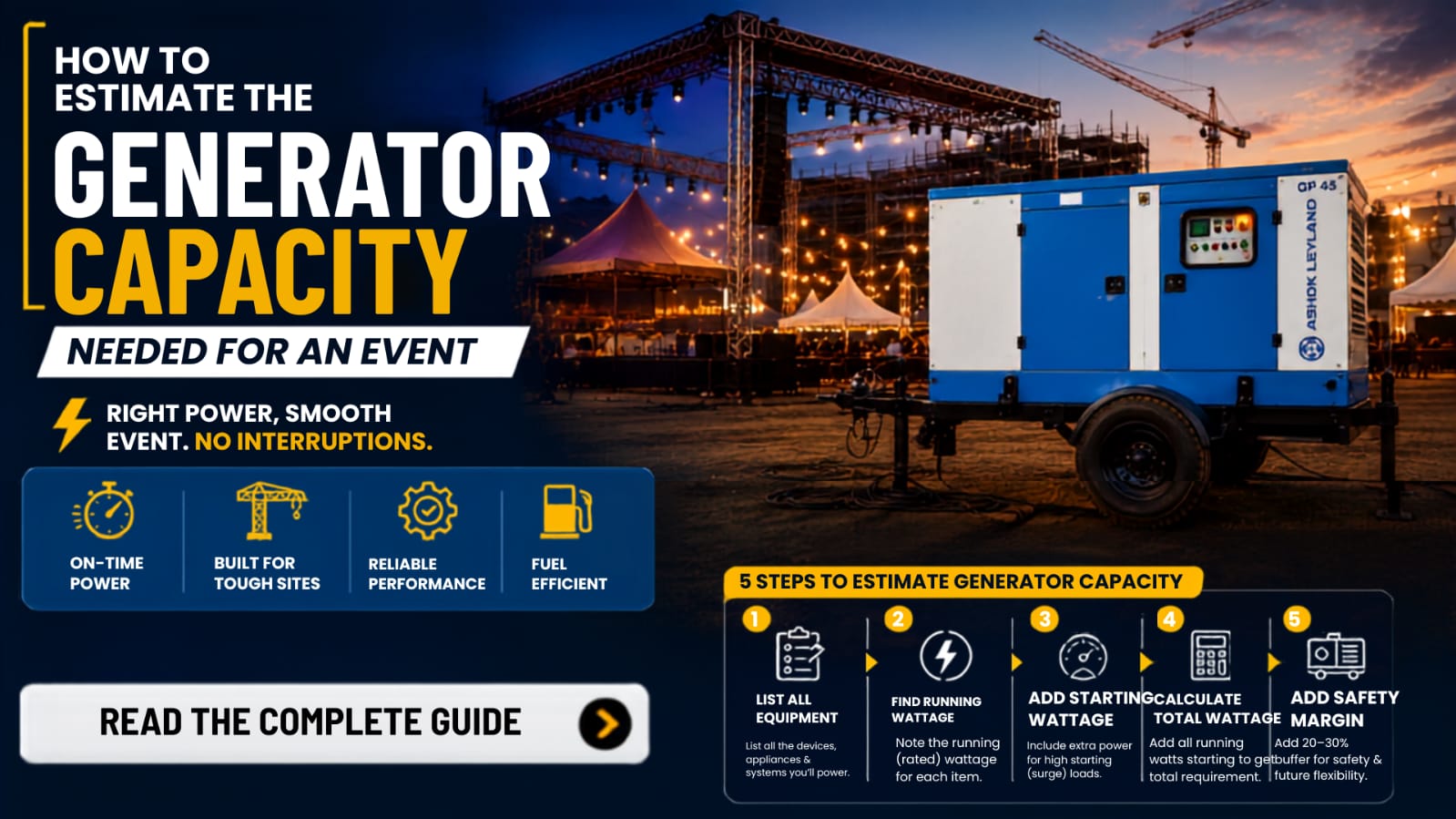
How to Estimate the Generator Capacity Needed for an Event
Preparing for an event includes ensuring that all required equipment is powered adequately. Lights, sound systems, air conditioners, catering equipment, and even screens could cause a complete disruption in the case of any power shortage.
This is the reason why proper generator sizing is very important when preparing for an event. If the generator size is small, there will be an overload, while a larger generator could lead to unnecessary fuel wastage.
Below is a guide to calculate the generator capacity required for an event.
1. List of Electrical Equipment
The first step is to create a list of all the electrical equipment required for the function.
Some common examples include the following:
- Lighting systems
- Sound system and speakers
- LED screen and projector
- Air conditioners
- Fan
- Refrigerator and freezer
- Cooking appliances
- Computers/laptops
- Battery charging units
- Booths and other electrical equipment
Create a list of equipment and their electrical load requirement that will be normally mentioned in watts (W) or kilowatts (kW).
2. Calculating the Total Power Requirement
Add up the power requirement of all the machines which can run at the same time.
For example:
| Machines | Power requirement |
| Lighting | 10 kW |
| Sound system | 5 kW |
| LED Screen | 8 kW |
| Air Conditioner | 25 kW |
| Catering equipment | 7 kW |
| Others | 5 kW |
| Total | 60 kW |
In the above case, the total estimated load is 60 kW.
But it would not be sufficient to use a 60 kW generator only.
3. Starting Loads
Certain pieces of equipment such as motors and compressors may need more energy to start than they do to operate normally.
Such items as air conditioning systems, refrigeration systems, pumps and other motorized equipment may consume more energy at startup.
Hence, it is important to consider the starting loads when sizing the generator capacity.
4. A Margin for Error
It is usually recommended to have a reasonable capacity margin as opposed to running the generator at its maximum capacity.
This means that if you estimate the operating load to be 60 kW, the generator capacity will vary depending on the load types, the starting requirements and the operating conditions.
A generator provider is able to provide guidance on the capacity margin required for a specific occasion.
5. Understand kW and kVA
Generator capacity is generally expressed using kVA, whereas other electrical loads may be expressed using kW.
Conversion between them is based on the power factor:
kW = kVA x Power Factor
For example, with a power factor of 0.8:
80 kVA x 0.8 = 64 kW
It therefore means that while selecting the generator, both the load and power factor have to be taken into consideration.
6. Take into Account Event-Specific Needs
The need for the generator can be very different from one event to another depending on the kind of event you are organizing.
While an outdoor small event might not need much generator capacity, an outdoor corporate event, a wedding, an exhibition or even concerts may need several generators running together.
The process of estimating the right capacity of generators required for an occasion does not only involve adding up the wattages of the electrical equipment. Some other elements that should be taken into account include connected load, starting current, power factor, and so forth.
By doing an effective load calculation, one is able to avoid overloading, become fuel-efficient, and provide for the effective supply of power during the occasion. In case of a complex situation or in case of high-power electrical equipment, it will be wise to ask experts for help in choosing the right generator capacity.
Post A Comment
Popular Posts
Should I rent a Diesel generator set or buy one ?
Comments (0)